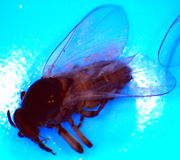
 Black fly Image source:
Charles Brockhouse |
|
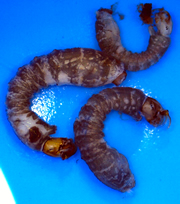
Black fly larvae
|
About the Project
Black flies (Diptera: Simuliidae) are the second most medically-important group of arthropod pest species affecting human health and are now the most important group of disease vectors and pest species lacking a representative genome project.
The family also occupies a critical taxonomic placement in the sub-order Nematocera, making it an important out-group for genomic studies in mosquitoes and other important hematophagous
Diptera are associated with leishmaniasis and viral encephalitis.
Simulium species are the sole vectors for the human filarial parasite Onchocerca volvulus, the causative agent of onchocercaisis, or river blindness. River blindness is a scourge of some of the poorest regions of the world, affecting 39 million people worldwide.
Historically, it has been the second most important infectious cause of blindness (after trachoma) and the second most important disease in terms of overall socio-economic impact, eclipsed only by polio. *
* Excerpted from: Simulium (Black Fly Disease Vectors) Genomics Project
Genomic Resources
-
Centers for Disease Control and Prevention: Filariasis
-
Ohio State University Extension FactSheet: Black Flies
-
Pennsylvania Departmant of Environmental Protection: Black Fly Suppression Website
-
UNHCO: River blindness
-
Whitepaper: Simulium (Black Fly Disease Vectors) Genomics Project
Additional Resources
Learn more about river blindness