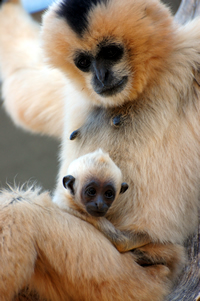
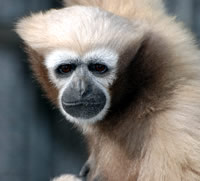
 Northern white-cheeked gibbon (Nomascus leucogenys) Photos by Gabriella Skollar at the Gibbon Conservation Center (Santa Clarita, CA) |
|
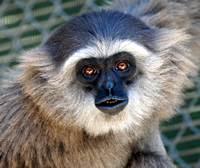
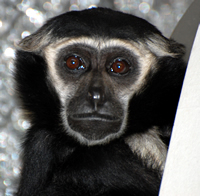
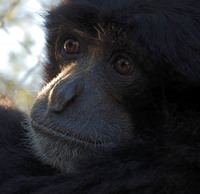
Diversity Panel
Hylobates moloch
Hylobates pileatus
Symphalangus syndactylus
Hoolock leuconedys
|
About the Project
The BCM-HGSC is sequencing and analysing the genome of the Northern white-cheeked gibbon (Nomascus leucogenys).
The gibbon is a small ape, an outgroup to the Great Apes that include humans, chimpanzees, gorillas and orangutans. Gibbons are estimated to have diverged from the hominoid common ancestor 18 to 20 million years ago. In contrast to these other primate genomes, the gibbon has undergone many chromosomal rearrangements. The genome sequencing project will provide important information about these rearrangements and the processes that shaped hominoid evolution and speciation.
The Gibbon Genome Sequencing Consortium is a collaboration between the Baylor College of Medicine Human Genome Sequencing Center, the Genome Institute at Washington University, and Lucia Carbone of Oregon Health & Science University. The goal of the project is to produce a high quality draft genome assembly of the Northern white-cheeked gibbon (Nomascus leucogenys) from Sanger sequencing data from clones of different sizes, including small insert plasmids, BACs, and fosmids.
In addition, comparative sequencing of gibbons from the 4 major genera of gibbons (Nomascus, Hylobates, Symphalangus, Hoolock) will provide information about the genomic diversity and process of speciation among these endangered animals.
The project is funded by the National Human Genome Research Institute (NHGRI).
Genome Assembly
| Released Name | Comments |
|
The assembly is described in detail in the README in that directory. Nleu_1.0 is a draft genome assembly produced from the Sanger sequencing data using the Arachne assembler. |
Diversity Panel
-
Hylobates moloch
-
Hylobates pileatus
-
Symphalangus syndactylus
-
Hoolock leuconedys
Genomic Resources
-
Gibbon Sequencing Proposal (paper)